Every band eventually discovers that the music is the easy part. Somewhere between the first paid show and the first tour, a set of unglamorous problems arrives: a promoter emails the guitarist’s personal address and nobody else sees it, the door money gets split from memory, and the contract for a festival slot lives in a direct message that scrolled away three months ago. None of this is why anyone picked up an instrument, and all of it decides whether the band survives its second year.

The good news is that the admin side of a band is small and finite. It comes down to one shared way of being contacted, one agreed way of handling money, and one place where the documents live. Set those up once and they mostly run themselves.
One Address the Whole Band Can Reach
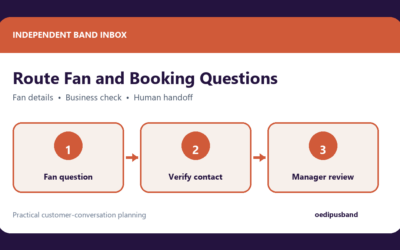
The single most common failure is contact routing. When bookings arrive at whichever member happened to be listed on a flyer, that person becomes a bottleneck, and offers get missed while they are at work or on tour with no signal. A shared band address that several members can read fixes it, and it also survives lineup changes, which personal addresses do not.
There is a credibility dimension too. Promoters, festival bookers and venue managers deal with a lot of acts, and a booking enquiry answered from a band address on its own domain reads as a group that has its act together. It is a small signal, but it operates at exactly the moment someone is deciding whether you are worth the risk of a support slot.
Agree the Splits Before the Money Lands
Money arguments end more bands than musical differences do, and almost all of them trace back to expectations that were never stated out loud. Have the conversation early, while the amounts are small and nobody is angry.
- Write down the performance split: equal shares, or weighted for someone who drives and stores the gear — either is fine, unstated is not.
- Handle songwriting separately: performance income and writing credits are different things and should be agreed as different things.
- Log expenses as they happen: fuel, strings, rehearsal rooms and merch printing come off the top, and only if someone recorded them.
- Decide about merch up front: whether it funds the band or splits like door money is a choice, and it needs to be a stated one.

The Paperwork a Tour Actually Needs
Touring generates documents whether you organise them or not: performance agreements, stage plots and input lists, hospitality riders, insurance certificates, van hire paperwork, and for anything crossing a border, the rules about carnets and work permits. A shared folder with a predictable structure turns a stressful morning into a two-minute search.
Keep a current stage plot and input list in there permanently. Sound engineers ask for them constantly, and the band that can send both within a minute of being asked gets treated noticeably better at load-in.
What This Costs to Set Up
Practically, you need a domain, a shared mailbox on it, and cloud storage the whole band can reach. A mainstream collaboration suite bundles the mail, the storage and shared documents in a single per-seat subscription, which for a four or five piece is a small monthly cost and one admin console for adding or removing members.
Bands are not flush, so it is worth checking prices before subscribing. Groups setting this up for the first time often look for a gsuite promo code, since the older G Suite name still appears in searches for what is now the same Workspace product. Start with the entry plan and only one or two seats if that is all you need; more can be added when the band does.
Do It in the Quiet Months
Nobody wants to spend a rehearsal setting up email. But the alternative is doing it during the week you are trying to confirm a tour, which is precisely when the missed message costs you something. Winter, or whatever your quiet stretch is, is the moment: buy the domain, set up the shared address, put the stage plot in the folder, and have the money conversation while there is nothing at stake.
When mapping out the communication infrastructure for a new group, treating the project as a formal entity from the start makes future paperwork much simpler. Sorting out centralized addresses for booking inquiries often prompts musicians to sit down and see what each Workspace tier actually costs in relation to their current tour income. Taking this administrative step during slower months prevents frantic scrambling later, ensuring everyone retains access to vital contracts.
Frequently Asked Questions
Do we need a formal band agreement?
A written understanding of splits, songwriting credits and what happens to the name if someone leaves prevents most disputes. Whether it needs to be a legal document depends on how much money is involved and where you are; worth asking a professional once the income is real.
Who should have access to the band email?
At least two members, so nothing stalls when one is unreachable. Access should be revocable by the band rather than tied to one person’s personal account.
What should live in the shared folder?
Current stage plot and input list, standard rider, performance agreements, insurance documents, high-resolution photos and logos, and the expenses sheet.

Disclaimer: This article is provided for general informational purposes only and does not constitute legal, financial, or tax advice. Rules on contracts, touring permits and income vary by country; consult a qualified professional about your own situation.



0 Comments